
AI vs Human Brain: The Wrong Question We Keep Asking
Ali Zain
Author
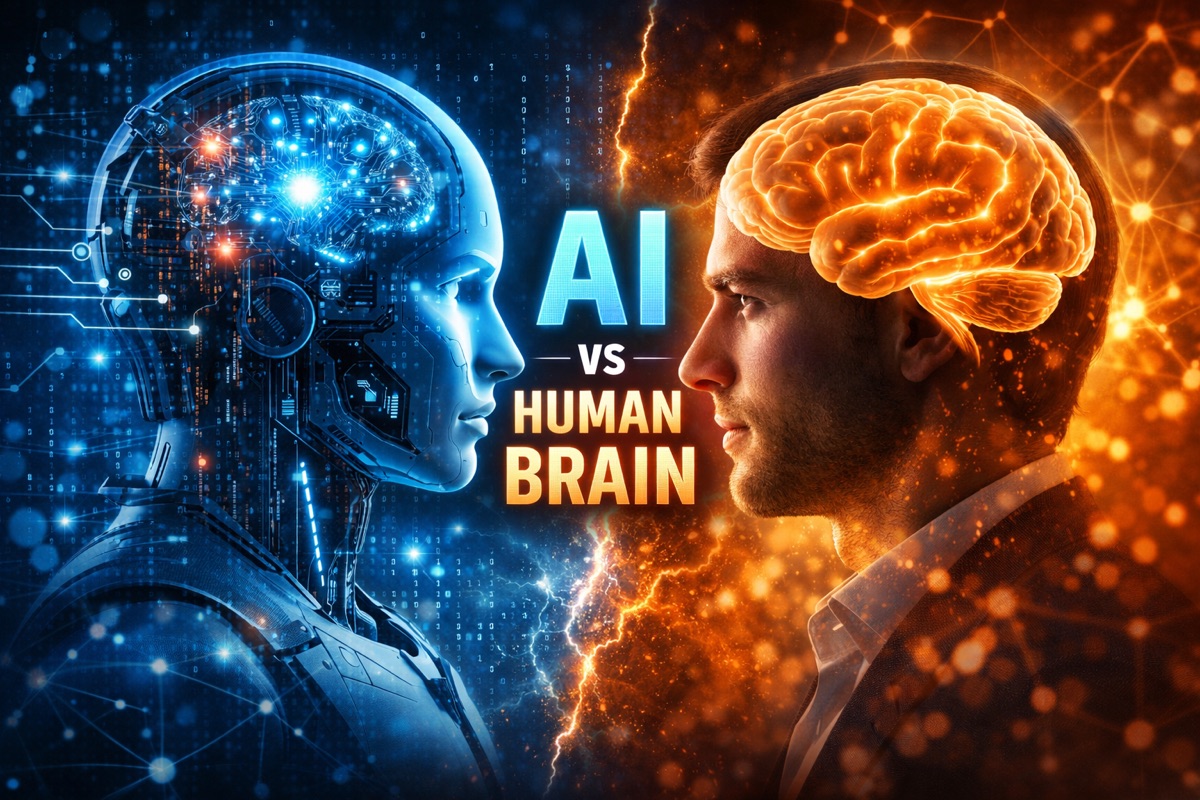
Artificial intelligence is advancing at an astonishing pace. From predictive analytics to generative AI systems, modern tools now write code, analyze customer behavior, and automate workflows at scale. This raises a pressing question many people are searching for: will AI replace the human brain?
Short answer: No. AI can automate tasks and analyze patterns efficiently, but it cannot replicate human consciousness, ethical reasoning, creativity, or contextual judgment. AI and human intelligence operate on fundamentally different principles. Understanding that distinction is essential for building smarter products and sustainable digital strategies.
Understanding What AI Actually Does
Modern AI systems function primarily as advanced statistical engines. They learn from large datasets and generate outputs based on probability and pattern recognition—not awareness or understanding.
Strengths of Artificial Intelligence
AI excels in environments where scale, speed, and repetition matter. It can process millions of data points in seconds, detect correlations invisible to humans, and automate operational workflows with high efficiency.
- Pattern Recognition: Identifies trends across massive datasets.
- Automation: Handles repetitive and rule-based tasks at scale.
- Predictive Modeling: Forecasts outcomes based on historical data.
- Scalability: Operates consistently across global systems without fatigue.
However, artificial intelligence does not possess awareness, intention, or intrinsic values. It does not understand meaning—it optimizes functions within defined constraints.
How the Human Brain Differs
The human brain is not optimized for perfect computation. Instead, it is optimized for interpretation, creativity, emotional intelligence, and decision-making under uncertainty.
Human Cognitive Advantages
Humans interpret incomplete information, weigh ethical implications, and imagine possibilities that do not yet exist. We decide not only what can be done, but what should be done.
For example, an AI system may determine that aggressive discounting increases short-term sales. A human leader evaluates whether that strategy strengthens brand positioning, preserves customer trust, and aligns with long-term goals.
AI identifies patterns. Humans assign meaning. Meaning is where strategy, culture, and innovation live.
Can AI Replace Human Intelligence?
AI can replace specific tasks, especially repetitive and data-driven ones. However, it cannot replace human intelligence as a whole.
Artificial intelligence can outperform humans in narrow domains like chess, mathematical optimization, or large-scale data analysis. But it cannot experience consciousness, form moral responsibility, or define long-term societal direction.
The Real Risk: Over-Reliance on Automation
The primary risk is not that AI becomes more intelligent than humans. The greater risk is that humans outsource judgment entirely to automated systems.
When AI outputs are treated as unquestionable truths rather than probabilistic suggestions, critical thinking declines. Over-automation can produce fragile systems where nuance disappears, bias goes unchecked, and innovation slows.
AI Augmentation vs Replacement
Forward-thinking organizations are not asking whether AI can replace their teams. Instead, they ask how AI can reduce cognitive load so teams can focus on higher-level strategy, creativity, and complex problem-solving.
A Balanced Division of Intelligence
- AI Handles: Speed, large-scale data processing, repetitive computation, and pattern detection.
- Humans Handle: Context, ethics, long-term vision, creative direction, and complex decision-making.
In this productive model, AI becomes an amplifier of human capability rather than a substitute for it.
Intelligence Is Multi-Dimensional
Intelligence is not a single measurable axis. Computational intelligence excels at narrow optimization within defined constraints. Human intelligence thrives in open-ended environments filled with ambiguity, emotion, and competing priorities.
A chess engine can defeat a grandmaster under fixed rules. But it cannot design company culture, interpret social nuance, or define a long-term product vision aligned with human values.
Preparing for a Hybrid Future
The future belongs to organizations that integrate AI deliberately while preserving human oversight. Businesses that understand AI’s strengths and recognize its limitations will build more resilient, innovative systems.
Success in the age of artificial intelligence will depend on collaboration between human reasoning and machine efficiency—not competition between them.
Conclusion
The phrase “AI vs Human Brain” makes for a dramatic headline, but the real opportunity lies in collaboration. Structured computation guided by human judgment is more powerful than either alone.
At Devtronics, we believe technology should extend human capability—not replace human responsibility. By combining intelligent systems with strategic thinking, businesses can innovate faster while maintaining clarity, adaptability, and long-term control.
Tags
About Ali Zain
Ali is a full-stack developer and startup tech consultant, helping businesses build scalable web applications.